





Are you looking for a crypto casino where there is no KYC requirement? A no KYC crypto casino lets you sign up and deposit without uploading ID, but most can still require verification before a payout.
This guide, containing 2,500+ words, walks you through everything that has to do with no KYC crypto casinos. We also show you what to look for, what to compare and a step-by-step walkthrough for opening an account without an ID card or passport.
Learn about no KYC crypto casinos, why players use them, and how to choose the best one.
Pick a no KYC crypto casino from our table and play with Bitcoin or other cryptocurrencies.
You can go and read any section by choosing from the chapters on the left-hand sidebar.
What is a no KYC crypto casino?
What is know your customer (KYC):
A no KYC crypto casino lets you play online casino games without any mandatory identity verification. KYC, which stands for “Know Your Customer”, is a mandatory ID verification process.
During KYC requirements, the player often needs to present a passport or ID card. The player might also have to take a selfie and show documentation of where the money comes from. In the case of no KYC crypto casinos, none of these requirements have to be met when opening an account.
How do no KYC crypto casinos work?
No KYC crypto casinos differ in what really needs to be presented. Some of them require only an email address and password, while others use a wallet-based login. There can also be differences in certain features available.
On some, there are certain limits of which game types can be played. On others, there might not be any requirement of KYC for signup, but it can somehow be required for withdrawal of funds. Thus, there exist different types of no KYC crypto casinos.

Example: At Cloudbet, identity verification is required once total deposits reach 2,200 USD. Documents may also be requested earlier. Withdrawals are capped at 2,200 USD per day until Level 2 verification is complete, as of late 2026.
Differences between no KYC crypto casinos:
Type | Explanation | |
|---|---|---|
1 | No account crypto casino | Creating an account may involve fewer steps. |
2 | No verification crypto casino | Register and play with fewer identity checks. |
3 | Anonymous crypto casino | Limited collection of personal data is emphasized. |
Learn more about how a crypto casino works
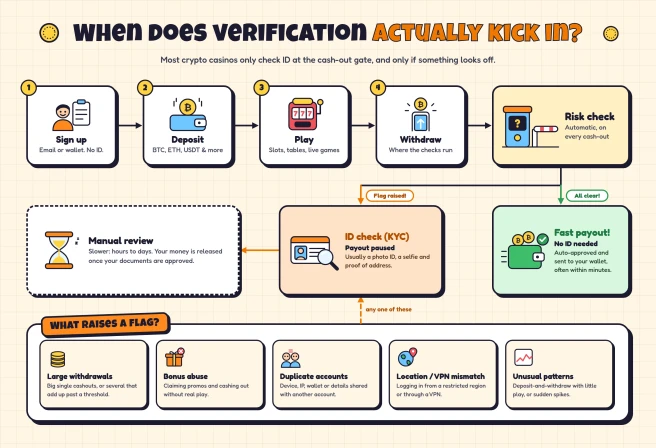
When does verification actually kick in?
Many no KYC crypto casinos require fewer identity checks during signup. However, verification may still be required later. For example, players may need to provide personal details or identity documents when requesting a withdrawal.
What usually happens in the account lifecycle…
1. Sign up – Sign up with an email, username and password, or connect a wallet.
2. Deposit – Crypto is often the main payment option, but methods vary between platforms.
3. Play – Start playing a casino game after funding your account.
4. Withdraw – Withdrawals may proceed as usual if no review is needed.
5. Verification – Verification may be requested based on account activity, withdrawals, location or risk checks.
How to choose the best no KYC crypto casino
When choosing between different no KYC crypto casinos, you should always start by looking at the withdrawal terms. This is where you can see how much control you actually retain over your money and anonymity.
The fact is that there are a lot of things to consider when choosing the best no KYC crypto casinos. Below is a table showing different factors that should be taken into consideration when choosing between different casinos.
Checkpoints to take into consideration:
Factors | What to check | Why it matters |
|---|---|---|
Company and license | Legal entity, domain, and registry record | You need to know who is responsible for the account |
Country and state | Both place of settlement and physical location of stay | An open form does not prove authorization |
KYC | Documents, timeframes, and aggregate amount limits | The check may occur after several deposits. |
Withdrawal | Minimum amounts, fees, processing, and limitations | These determine how useful the balance is |
Game selection | The games you actually want to use and their rules | A high total number says little about relevance. |
Customer protection | Limits, self-exclusion, and complaints process | The support needs to work even when something goes wrong |
Questions to ask before making a deposit
Do previous deposits count toward the limit?
Can the casino request an ID even for a small withdrawal?
Is a wagering requirement applied even if I decline the bonus?
Besides asking these questions directly of customer service, and reading through the policy and guidelines, you can also directly compare the crypto casinos by trying them out.
An easy way to compare them is to make a small deposit to see how the platform works, if they ask for some kind of identity requirements. Deposit a small amount, for example 10–50 USD, and try out the platform.
How to get started: step by step
In this chapter we walk you through step-by-step on how to get started with no KYC crypto casinos. We show you how to open an account, prepare your wallets, check the currency, network, address and start off with a small amount of money.
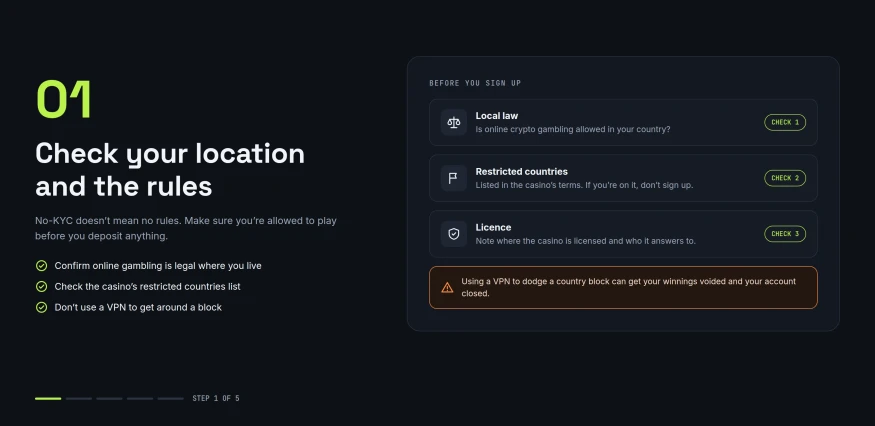
Step 1 – Check your location and the rules
The first step in the process is to check the regulations in your current location and whether the operator accepts customers from there. Consider both the country and the state.
Review the age requirements and apply the highest applicable limit. You should always provide accurate information about yourself, and not use technical workarounds to conceal a prohibited location.
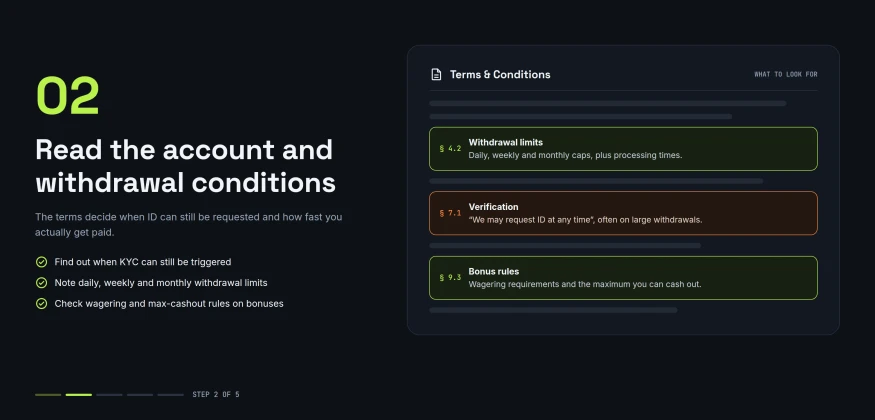
Step 2 – Read the account and withdrawal conditions
Read the KYC, bonus, and withdrawal terms and conditions before registering an account. At the same time, you should also decide how much time and money you want to spend on gambling.
Money intended for rent, bills, or savings should not be part of your gambling budget. You should only play with money that you actually can afford to lose.
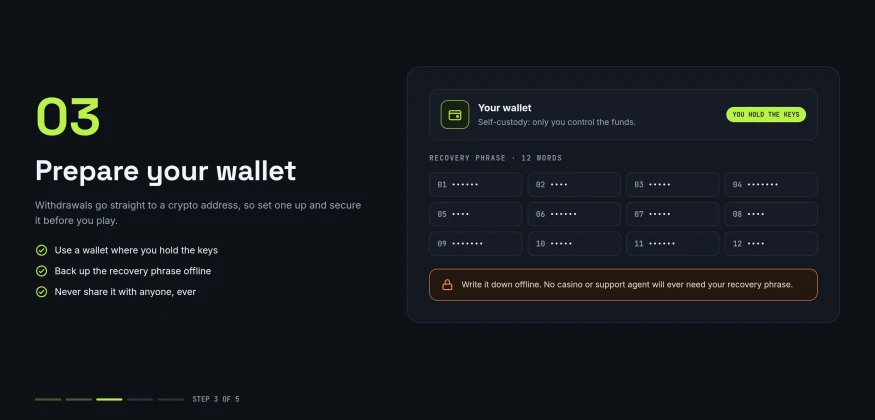
Step 3 – Prepare your wallet
The next step is to choose a wallet that supports the currency and network you intend to use. With your own wallet, you are responsible for access to the keys.
Our guide to Bitcoin and crypto wallets explains the different setups and what you need to consider.
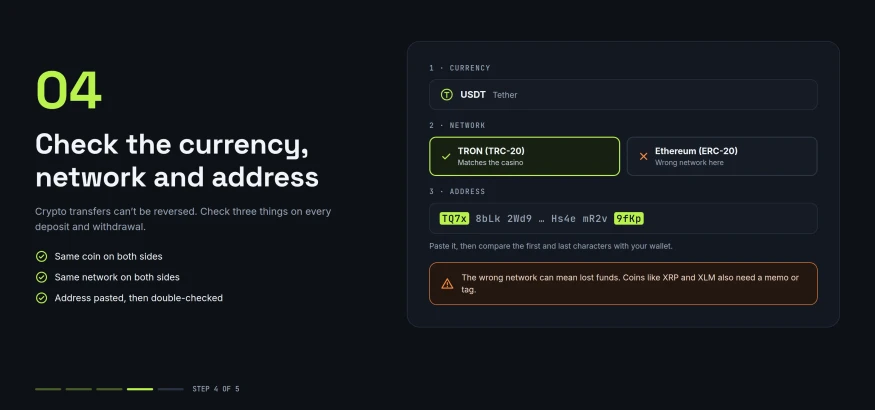
Step 4 – Check the currency, network and address
Ensure that both the sender and the recipient are using the exact same network. If the casino displays USDT on Ethereum, do not send USDT via a different network, such as Tron.
Just because the token name is the same doesn't mean it will work using different networks. Also, check for any required memo or destination tag, as well as minimum amounts and fees.
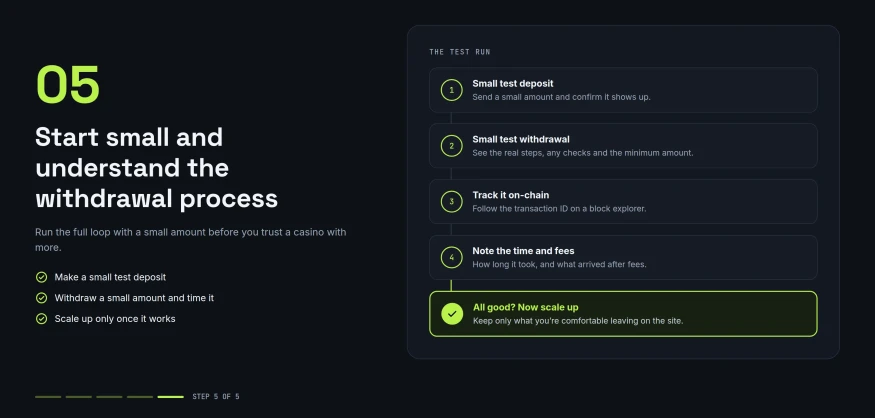
Step 5 – Start small and understand the withdrawal process
Once everything has been verified, making a small initial transfer can reduce the risk of a costly error regarding the destination address. It can be as little as 10–50 USD. Review the withdrawal process and any wagering requirements before you start playing.
Furthermore, a successful small withdrawal is no guarantee of how a subsequent withdrawal will be handled. In some cases, the casino might ask you for a KYC verification if you try to withdraw too much at the same time.
When do no KYC casinos ask for ID?
Identity checks may be required on various occasions, depending on the operator’s policy. This does not necessarily relate to an unusually large win or cumulative deposits. In the table below, you’ll find situations where identity checks may be required.
When identity checks may be required:
Situation | What might need to be clarified | Examples of supporting documentation |
|---|---|---|
A published threshold is reached | Customer identity | ID document and, if applicable, a selfie |
Address details need to be confirmed | Where the customer lives | Acceptable proof of address |
Source of funds is examined | How the gambling funds were acquired | For example, account statements or proof of income |
The account or payment is anomalous | Who is using the account or controlling the wallet | Information according to the operator’s verification process |
Published thresholds and cumulative amounts
Example: In a hypothetical example, a casino might have a limit of 1,000 USD. Let's say you deposit 400 USD, followed by another 600 USD. The limit has now been reached, even though no single deposit amounted to 1,000 USD.
You should not attempt to structure your payments in a way designed to evade checks. A stated limit defines a condition. It does not grant a right to avoid verification simply by staying below that threshold.
You must consider whether you are able and willing to meet the operator’s requirements should they be triggered. If the answer is no, this should be clear to you before you make your first deposit.
Also, check the currency in which the limit is denominated. An amount specified in dollars will not necessarily equate to the same amount of Bitcoin at different points in time as the value of the cryptocurrency might change.
If the terms and conditions do not specify how the operator calculates this value, be sure to ask the customer service or read through the FAQ sections.
What happens if you refuse verification?
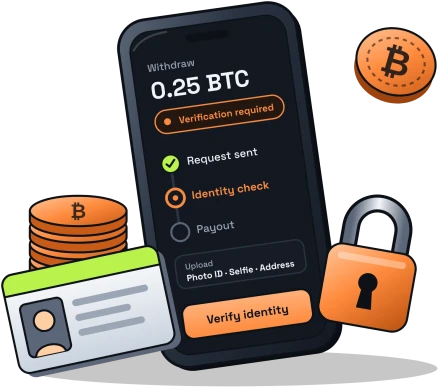
If a payout requires verification, it may be placed on hold while the matter is investigated. A frozen withdrawal does not automatically mean that the funds have been forfeited.
You should ask which specific term or condition the requirement is based on, what documentation is needed, and how it can be submitted securely. Furthermore, you should not send additional funds to "unlock" a withdrawal, nor disclose your wallet’s private keys or seed phrase.
Best cryptocurrencies for deposits and withdrawals
The most practical cryptocurrency is one that is supported by both the crypto casino and your personal wallet on the same network, with a cost that is appropriate. When choosing a casino and cryptocurrency, you should consider the entire payment chain.
It is of little help to choose a cryptocurrency with a low network fee if the operator itself charges a high withdrawal fee. Thus, you should always read about their fees and costs before proceeding with your first deposit.
6 commonly used cryptocurrencies for no KYC crypto casinos
For general purposes, there are a few cryptocurrencies that are the most commonly used ones, and that are popular for specific reasons.
Cryptocurrency | Property to know about | Check before the transfer |
|---|---|---|
Public transaction history and fluctuating exchange rate | Confirmations, fee, and potential support for Lightning | |
The network fee is paid in ETH | Which Ethereum network is actually supported | |
Litecoin | Dedicated blockchain and proprietary asset price | Minimum deposit and number of confirmations |
USDT | Stablecoin that exists on different networks | Correct network, token version, and fee |
USDC | Stablecoin supported on multiple blockchains | The correct network and the acceptance of the token version |
Solana | Transaction fees are paid in SOL | Address, operational status, and recipient requirements |
Bitcoin and Ethereum are accepted almost everywhere. If you already know that you want to use these coins, our guides to the best Bitcoin casinos, best Ethereum casinos, and best Tether casinos compare sites that specialize in each.
Network speed is only part of the waiting time
The network speed varies for different cryptocurrencies and blockchains. However, there are two specific things that can have a major impact on speed.

1. The network
The first one is the blockchain network itself. Depending on the transaction volume of the network, the time can differ on how long a transaction actually takes.
Example: On the Bitcoin network, a new block is mined every 10 minutes on average. Each block has limited space, so when the network is busy, your transaction may have to wait for a later block. This can delay confirmation, especially if your transaction fee is low.
2. The operator
The operator itself might delay your transaction in certain cases. In the worst case, it can take more than 24 hours to get your money back when making a withdrawal.
You should always read carefully through the operator's policy about time for transactions, just to give you a perspective of how long it can actually take.
No KYC casino bonuses and promotions
Cashback bonus explained – Lose less, play more:
A bonus can provide extra playing funds, but the terms and conditions determine the offer's true value. You should always start by distinguishing between the bonus amount displayed on the screen and the funds actually available for withdrawal.
Deposit bonuses
A deposit bonus is calculated based on the total amount you deposit. For example, a 100 % bonus offer would grant you 50 USD in bonus funds when you deposit 50 USD. If the wagering requirement is 20 times the bonus amount alone, you would need to place a total of 1,000 USD (50 x 20) in qualifying bets.
If the same requirement applies to both the deposit and the bonus, the total wagering amount becomes 2,000 USD (100 x 20). This figure represents the total amount that must be wagered. It does not indicate how much you will win or lose.
Also, check which games qualify and what percentage of each bet contributes toward meeting the requirements. This can differ between different casino games.

(Source: Whale Portal)
The time limit…
The time limit is another important factor. A bonus that must be wagered within a few days might require more gameplay than you originally intended.

Note: You should never increase your budget just to take advantage of an offer. Instead, compare the terms against the time and money you have already allocated.
No deposit bonuses and free spins
A "no deposit" bonus does not require an initial deposit to activate. However, any winnings may be subject to…
wagering requirements,
time limits,
withdrawal caps, or
identity verification.
Therefore, "no deposit" does not mean that winnings can be withdrawn without any conditions.
Free spins
Free spins consist of a set number of game rounds. You should check which games they apply to, the value of each round, and how any resulting winnings are handled.
One hundred rounds with a low stake value are not necessarily more useful than a smaller offer with simpler rules. Therefore, check it out carefully.
Cashback and other restrictions
Cashback may be calculated based on certain losses incurred over a specific period. Find out what qualifies as a loss and whether the refund is provided as cash or as bonus funds.
Remember that any offer is optional. Feel free to decline it if the terms do not align with your usual style of play.
Pros and cons of no KYC crypto casinos
Pros of no KYC crypto casinos
 Less paperwork upfront – You may be able to open an account without having to upload documents such as passport, ID card or proof of address. This reduces the documents you need to prepare initially, which makes the process easier.Higher privacy – Without the need of having to present a passport, ID card or proof of address, your privacy is higher at no KYC crypto casinos. However, the casino may still collect account, device and transaction data when wanting to withdraw funds.No initial verification wait – No KYC crypto casinos let you deposit and play without completing any identity verification. You can therefore avoid waiting for document approval at the start, which makes the process much quicker.
Cons of no KYC crypto casinos
 No guaranteed anonymity – Skipping identity checks does not make your payments 100 % anonymous. Bitcoin transactions are publicly recorded, and wallet activity can be linked to your identity.Deposit and withdrawal limits – Unverified accounts may have lower transaction limits. You might need to complete identity checks before depositing or withdrawing larger amounts. For example, Cloudbet has a cumulative-deposit limit of up to 2,200 USD as of late 2026.Withdrawals can be delayed – If verification is requested when you want to withdraw funds, you may need to submit documents and wait for approval before receiving your funds. This can prolong the processing time.
No KYC crypto casinos typically allow you to begin playing without completing identity verification first. These checks are known as KYC, meaning “Know Your Customer”.
There is no clear “yes” to whether no KYC crypto casinos are legal in the US. The fact that a foreign operator accepts U.S. customers does not mean it holds a state-level license. For example, Michigan has taken action against several operators that lacked a local license. Thus, it is not safe to say that all no KYC crypto casinos are legally authorized in the US.
Yes, depending on the terms and conditions, documentation may be required before a withdrawal is paid out from a no KYC crypto casino. Therefore, make sure to review the specific KYC policy and withdrawal rules before depositing funds.
Yes, US taxpayers must report taxable gambling winnings. The lack of formal documentation does not change this requirement. Therefore, be sure to keep records of your gambling history, cryptocurrency transactions, and the relevant dollar values.
Yes, since January 1, 2026, US federal rules limit deductible gambling losses to 90 % of your losses, capped at your winnings. For example, if you win 10,000 USD and lose 10,000 USD, the deduction is limited to 9,000 USD, leaving a 1,000 USD difference—even though you broke even.
Whether you can use a VPN for registering and playing at a no KYC crypto casino, or not, depends on the specific terms and conditions and how the service is used. Some crypto casinos do not allow such manipulation of location data.
No, the absence of document checks does not mean complete anonymity. For example, Bitcoin transactions are public. A wallet address can always be linked to an individual through other information.