Image source: AI generated
Economic success is built upon a variety of factors, but one of the fundamentals of it is the ability to predict future events. It is why so many economists and experts in the field build theories and algorithms around attempting to forecast where the market is going to go. Traders and investors have historically engaged with these theories in order to improve their chances of scoring big.
But as things change and technology improves, new and exciting ways to make predictions hit the mainstream. Even more important is the fact that new markets arise that could greatly benefit from economic forecasts. One such industry is the relatively new crypto trade. Operators now offer prediction markets on cryptocurrencies, with one example being the PUBS prediction market which combines the new passion for crypto and online betting.
The marriage of cryptocurrency and sports betting may lead many to believe that prediction market and sportsbook odds are not too far off. And while it is true that they are relatively connected, we also must remember that there are major differences. That is what we are trying to explore in this article.
What are Prediction Markets?
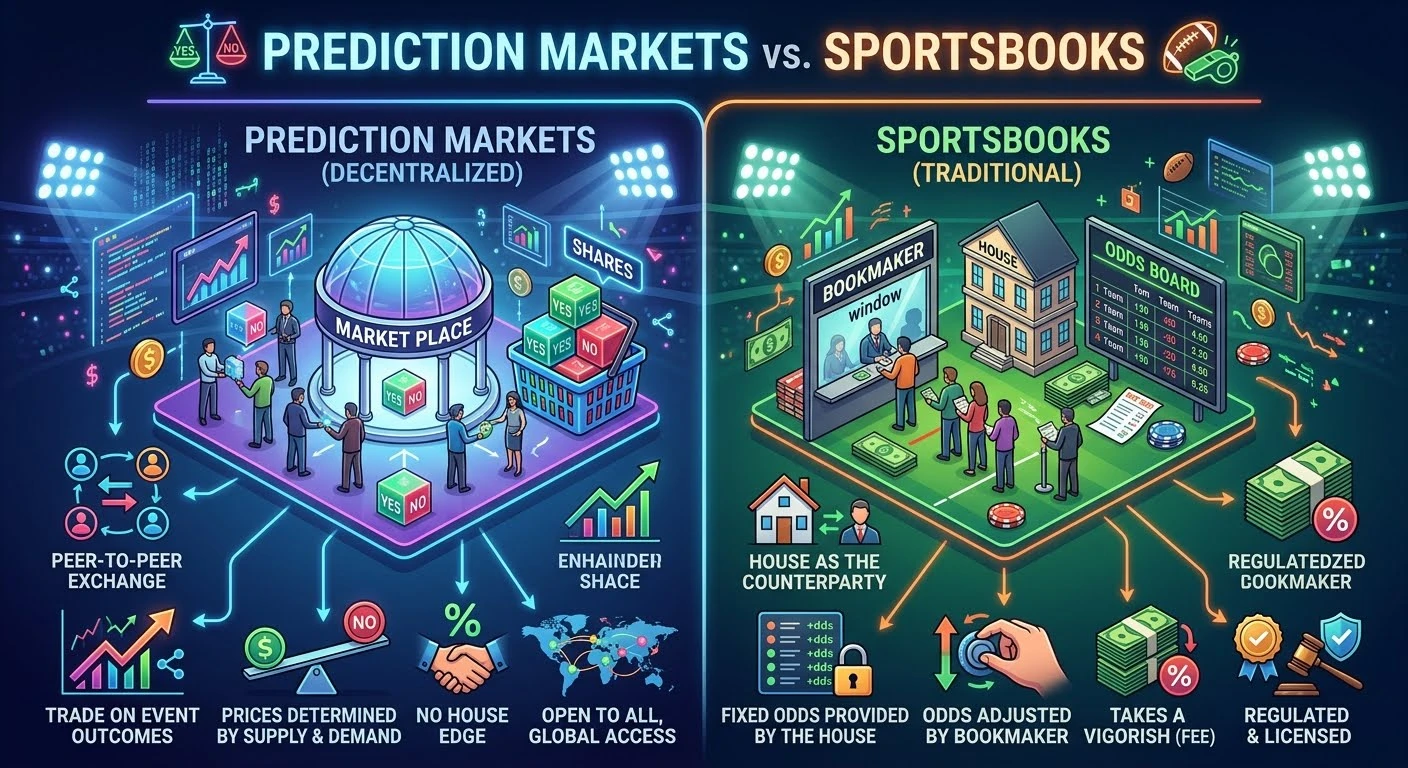
Prediction markets are a new and exciting way to engage with the world of trading. Online casinos have found a way to make entertainment out of economics, a task which many hitherto have considered impossible. These peer-to-peer exchanges allow participants to trade, sell and buy shares on the likelihood of an event occurring in the future. But who determines the worth of these shares? That is where it gets interesting. The value of each share is determined entirely on the participants’ belief of the likelihood it will occur.
One can certainly see how prediction markets are similar to sports betting odds. Odds makers operate on much the same logic after all. They analyze data, statistics, player performance and more and determine how likely it is for one sports team to win in an up and coming match. But there is a major difference between the two. Namely, sportsbooks are centralized platforms, where the participants make wagers against the house itself. There is no peer-to-peer competition and the value of each wager is determined entirely by the bookmaker themselves.
Where Does Crypto Come in?
Whenever decentralization is being discussed, a reference to crypto is not far behind. The reason that the term has become such a staple of most people’s vocabulary has a lot to do with Bitcoin’s massive success in the past few years. The decentralized and encrypted currency continues to fascinate and inspire many of the modern traders today. And it also plays a key role in the proliferation of prediction markets.
Crypto prediction markets are the natural evolution of the modern betting and trading industry. They are blockchain-based platforms that allow users to buy shares on the outcomes of real world events. Newbies to this concept may not realize just how developed crypto prediction markets have become. It goes far beyond a simple wager on a “yes” or a “no.”
How Do Crypto Prediction Markets Work?
The success of the crypto prediction market sector may inspire some to seek out a platform and begin participating in this new way to wager. This is where sports betting enthusiasts might come across some familiar tropes. The most obvious one is the binary betting option. With crypto prediction markets, as is the case with many bookmakers, the participants get the option of backing the “yes” or “no” options. The options refer to the likelihood of an event taking place, meaning that you are essentially buying shares on whether it will happen or not.
In other words, the whole concept is very similar to a simple match bet. In match betting, the participants bet on which of the two teams is going to win the game. It is a binary choice without much room for complexity. But what happens when the participants have decided which option they want to buy shares in?
That is where they have to use cryptocurrency to buy their shares. Most crypto prediction market operators ask that their customers utilize a stablecoin of some kind when purchasing a share. Usually, the stablecoin is going to be USDT, as it is the most popular of those that are available to the market. Tether being pegged to the U.S. dollar also makes it one of the most reliable stablecoins on the crypto market right now. The settlement occurs when whichever event finally takes place, wherein the authorized operators verify the result and pay out the shareholders’ winnings.
The Current Prediction Market Landscape
When fans discover a new market, they will inevitably be curious about two major factors. The first is the sector’s current status and future potential. The good news is that the crypto prediction market is in a very good position right now. For one thing, cryptocurrency is at a point in history where it is garnering respect from respectable figures. Even some nations have jumped on the bandwagon, with Turkey, Switzerland and Singapore drafting laws that are very beneficial to the market.
The other thing is that the market is a financial success. Crypto prediction markets are currently generating billions. Experts value the market at over $7 billion today, with potential for growth by the end of the decade. But there is one other thing that customers should be thinking about. That is of course the regulatory bodies that are in charge of controlling this emerging market.
Regulation of online markets is always going to be difficult to peg down. The prediction market sector in the United States is thriving, and the CFTC continues to vein. Trump’s staff reductions have played a significant role in weakening the Commodity Futures Trading Commission’s power in this regard. Overseas in Europe, countries are strengthening their own restrictions on gambling and cryptocurrency, both of which affect the success of the crypto prediction sector. But even with these regulatory measures taking place, many experts believe that this new way to trade is going to be a major success.