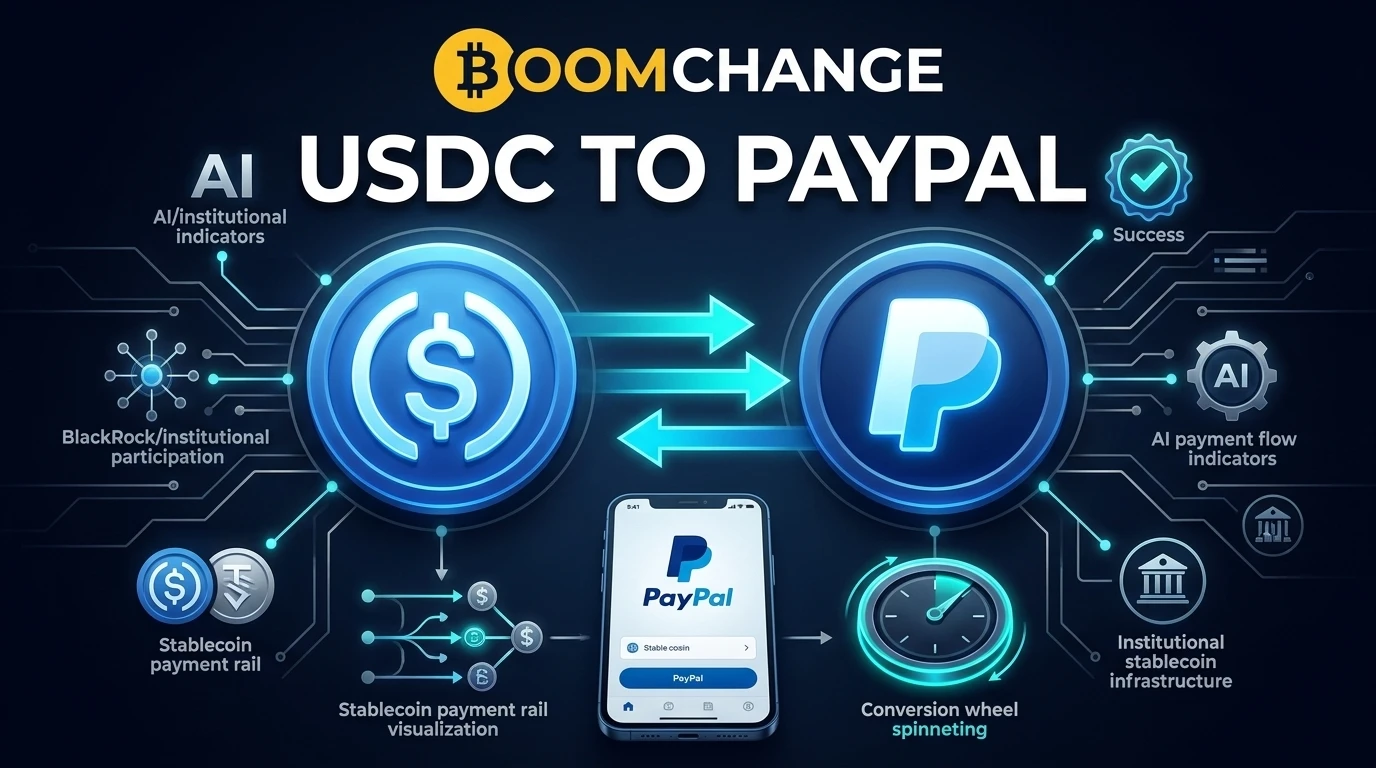
Boomchange and AI Payments: BlackRock Highlights the Growing Role of Stablecoins
Introduction
Stablecoins are playing an increasingly important role in the digital payment system. While they were once primarily known for their role in trading cryptocurrencies, their role has grown to include payments, settlement, digital commerce, and transferring value on blockchain platforms. Their relatively stable value makes them more practical for monetary transactions than highly volatile cryptocurrencies. This move has also spurred financial institutions and tech firms to consider the role that stablecoins can play in the next-generation digital payment system.
With the swift evolution of AI, the conversation is gaining a new level of significance. AI systems are beginning to shift from mere information processing to action and interaction with online services and initiating digital actions. As these systems evolve to be more autonomous, they might need a payment system that can function continuously, be programmatic in nature and be able to settle transactions quickly and efficiently. BlackRock mentioned some of these attributes when it spoke about the role of stablecoins in the future of digital finance.
However, for individual users it can be much simpler in practice. Individuals with USDC already in their wallets may not need to worry about AI-powered commerce or the future of financial systems. Instead, the immediate goal is simply to convert USDC into funds that can be used through a familiar payment platform such as PayPal. A conversion service like Boomchange can offer a link between cryptocurrency assets and traditional payment systems in this context.
Stablecoin Basics
Stablecoins are cryptocurrencies backed by a different asset, usually a fiat currency like the U.S. dollar, which are engineered to have a stable value. Among the more popular is USDC, which is designed to be equal to around 1 U.S. dollar. This is a key difference from other cryptocurrencies like Bitcoin or Ethereum, which can have volatile market prices. Stablecoins are better for payments, transfers and quick short-term value storage, due to their greater level of price stability.
This stability extends beyond cryptocurrency investment, enhancing their versatility. Stablecoins can be employed by people and companies to move money from one wallet to another, from exchanges to apps and digital services, providing them with a level of protection against volatile price movements. This has led to the growing acceptance of stablecoins as viable financial tools and not just speculative investments. This will make their functions increasingly intertwine with the overall evolution of the blockchain-based payment system.
AI and Payments
AI is getting better and better at doing things that used to have to be done by people. AI systems today can access software tools, search, communicate with digital platforms, and execute other types of automated tasks. As the technology evolves, some of these AI-powered systems may eventually require some sort of data payment, computing power, subscription, and so on. This places a requirement on automatic systems that will have to be able to make payments effectively.
Traditional payment methods were mostly developed to facilitate payments by individuals or organisations. In contrast, systems that rely on AI can demand infrastructure that is able to operate around the clock and execute transactions based on a set of digital instructions. Stablecoins are important in this regard because blockchain networks can function 24/7, allowing values to flow without the constraint of traditional banking hours. They are programmable, so they could perhaps be appropriate for some automated sales.
BlackRock's Perspective
BlackRock has emphasized a number of attributes that could make stablecoins more relevant in the future financial systems. These include guaranteed availability, relatively swift settlement and the capacity to back programmable payments. In digital settings where automatic transactions are required instead of the manual ones, the above-mentioned attributes become especially significant. The overall message is that payment systems might slowly be becoming more fused to software and automated systems.
The concept of programmable payments is particularly pertinent when talking about AI. Software might be programmed to take the action of making a payment on specific events, such as access to digital resources or when an automated transaction occurs. This kind of infrastructure may one day facilitate machine-to-machine economic activity where software exchange value directly. Though in development, the concept illustrates the growing consideration of stablecoins in the context of AI and digital commerce.
Role of USDC
USDC is significant in the stablecoin space due to its dual nature of being backed by dollars and transferable on the blockchain. This is good for users because they can more easily comprehend the approximate value of the asset compared to a volatile cryptocurrency. Meanwhile, USDC can flow through blockchain infrastructure, and be utilized in a wide range of digital platforms. These attributes make it ideal for common transfers and more intricate applications of payments.
One of the other popular features of USDC is that it can be used on several blockchain networks. Currently, the USDC is found in 38 different blockchain networks on Circle, and users can choose their preferred way to store and transfer the asset. This does present an important technical consideration as the same token (USDC) can be on multiple networks. Users have to be aware not only of the asset they are sending, but also of the blockchain network where the operation will be performed.
USDC and PayPal
While both USDC and Paypal are capable of being used for the transfer of value, they are used in different financial environments. USDC has a blockchain-based digital asset while PayPal has a centralized payment platform, its account structure, payment services, and eligibility requirements. This has created a distinction between a USDC balance stored in a cryptocurrency wallet and standard PayPal balances. It may then be necessary to perform an extra conversion from one system to the other.
PayPal has expanded its crypto functionality and supports USDC in some crypto-related features. The exact functionality available to a user will, however, vary due to a variety of factors, including location, eligibility of the account, and the type of PayPal product being used. Users should not expect, therefore, to be able to link every external USDC balance to their PayPal account directly in the same manner. When functionality is not available for a direct conversion, a supported conversion route may be required.
Conversion Process
A USDC-to-PayPal conversion is not the same as a standard cryptocurrency transfer. Typically, in a standard crypto transfer, the asset is transferred from one blockchain address to another, but maintains the same form of a digital asset. A conversion, on the other hand, is intended to move the value of the cryptocurrency into another payment system. The goal is to move the value of USDC into funds available through the chosen payout option.
The procedure typically starts with the user picking the desired conversion path and analyzing the transaction instructions. The service may include data regarding the accepted blockchain network, payment, payments destination, exchange rate and other conditions. Once the mandatory USDC is sent and the blockchain side of the deal is settled the payout can be done on the selected Paypal route. It is always best to check the exact rate, charges, time and the disposition of the funds before confirmation.
Network Selection
The blockchain network is one of the most important technical details in a USDC transaction. USDC has multiple networks and simply looking at the token name is not enough to ensure compatibility. There might be a mismatch between the blockchain on which a wallet shows USDC and the blockchain that the selected conversion path supports. When a transaction involves a network mismatch, it could either be delayed, rejected, or hard to recover.
It is advisable, therefore, for users to check the supported network before sending any funds. The network provided by the conversion service should match the network selected in the sender's wallet. This check is just as important as verifying the amount or destination information. Taking a few moments to confirm the network can reduce avoidable transaction problems.
Transaction Review
The user needs to check every transaction thoroughly prior to sending cryptocurrency. Major factors to consider are the amount of USDC being moved, the estimated payout, the exchange rate, applicable fees, and the blockchain network being used. It is also important that users check that the PayPal destination data has been entered correctly. These checks are especially significant as blockchain transactions are usually hard to reverse once confirmed.
The final payout terms should also be reviewed rather than focusing only on the amount of crypto being transferred. The user should know the amount they should receive, whether any fees apply, and whether processing conditions may affect the transaction. If you are using a conversion service for the first time, you might also want to start with a smaller amount so you can get used to the process before you send a bigger amount.
Practical Use
A typical example is a freelancer receiving part of their earnings in USDC and paying regular bills via PayPal. The person might choose to accept some payments in cryptocurrencies and use PayPal for other payments such as subscriptions, purchases, online services, etc. or for further financial activities. In that case, the purpose of the conversion is not cryptocurrency trading or price speculation. It is simply a practical transfer of value between two financial systems.
The same may be true for those who have been holding USDC for some time and then want to transfer some of their holdings to a more comfortable payment system. For daily transactions, the user might prefer to have the funds readily available instead of locked within a cryptocurrency wallet. Boomchange can be seen as a conversion path here because it bridges between an existing crypto balance and a chosen payment method, without the user needing to think of the act as a standard trading maneuver.
Stablecoins and Automation
The connection between stablecoins and AI goes beyond single conversions. As digital systems become more autonomous, they may be able to carry out more economic activities with less direct human involvement in every step. An AI-powered application might need to pay for access to data, cloud computing services, a digital subscription, or other small transactions. To enable such activities, the payment systems would need to be able to interact efficiently with software.
In this setting, stablecoins could prove useful as they offer a relatively stable value coupled with blockchain-based transfer capabilities. Their ability to operate around the clock also makes them relevant to systems that do not follow traditional banking hours. Further, programmable blockchain infrastructure can enable transactions to be executed if specific criteria are fulfilled. These attributes help explain why stablecoins are being studied as a potential part of future automated payment systems.
Everyday Utility
While the entire conversation about artificial intelligence and programmable finance continues, there are many stablecoin transactions that are simple and useful. A user may simply prefer to move funds into a payment platform they already know and use. In this context, the significance of stablecoin infrastructure is not limited to advanced financial technology; it can also support ordinary transfers between different financial environments.
For users who are trying to convert USDC to PayPal, the most important considerations are practical rather than theoretical. They should understand the difference between a blockchain transfer and a crypto-to-payment conversion, ensure that the correct network is being used, and carefully check the rate, fees, and destination information. These checks make the process easier to understand and reduce the risk of mistakes that may be difficult to correct after a blockchain transaction is confirmed.
Future Outlook
Stablecoins are becoming a middle ground between the blockchain financial world and traditional payment systems. They can circulate through the digital networks without losing their meaning for everyday use. Meanwhile, financial institutions and tech firms are looking into their future applications in settlement, programmable payments, automated commerce, and AI-powered financial transactions. This association renders stablecoins more versatile than they were in the initial phase of cryptocurrencies.
Services like Boomchange are a more practical aspect of this trend for individual users, enabling the transfer of value between cryptocurrency and well-known payment methods. The overall technology could still progress toward more automated forms of commerce, but the underlying need remains the same: users should have a reliable way to move value between various financial systems. Stablecoins are becoming an increasingly important part of that connection.