
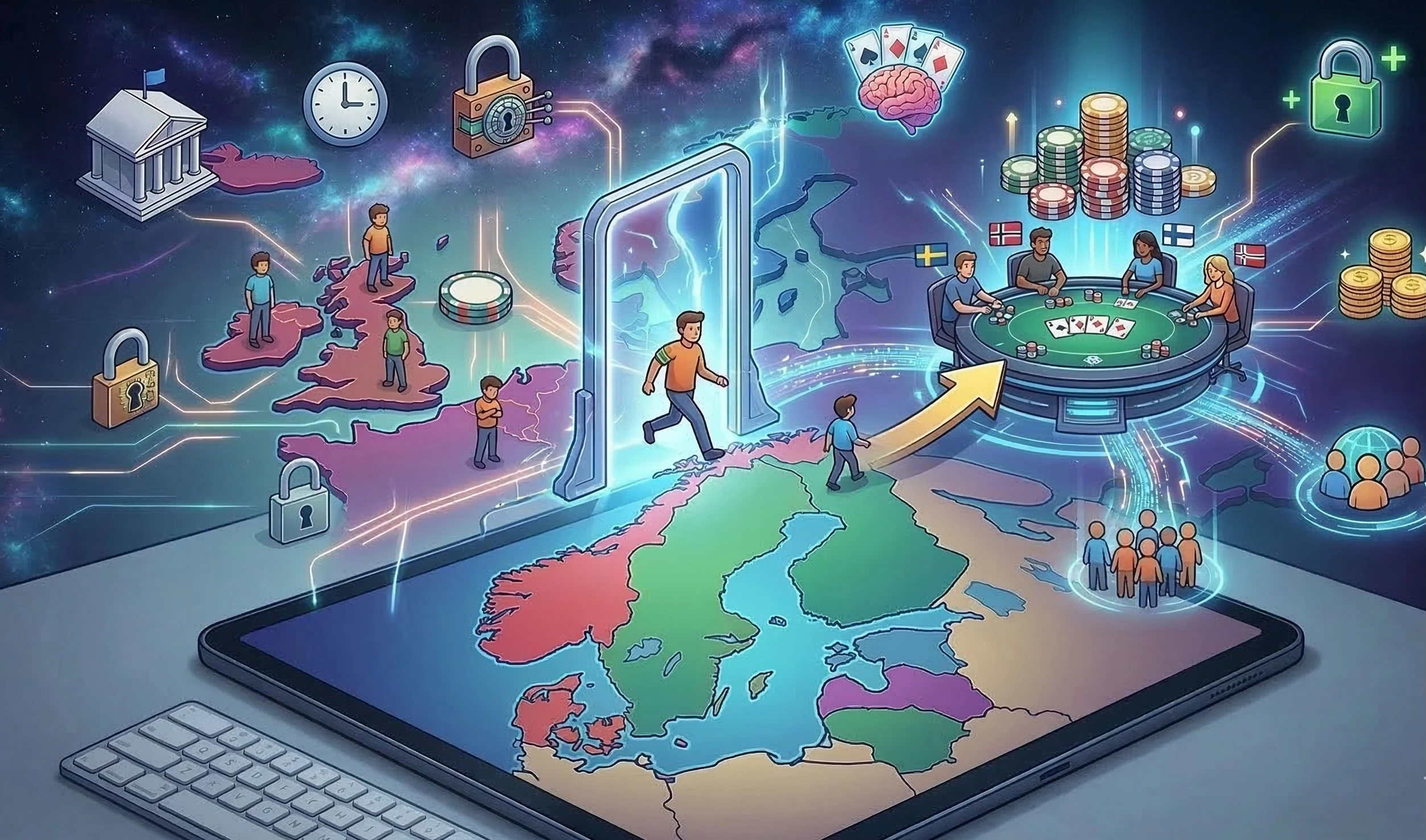
A multi-state poker agreement allows jurisdictions to share players. This can boost numbers and increase revenue in the gambling sector.
The Scandinavian countries are each at different points in their formation of gambling legislation. Generally, the consensus is that a free market with licensed operators is the direction to take. Yet channelisation rates are still low, and one way this could be rectified is with a multi-state poker agreement, which would allow states to share players across borders, leading to bigger tournaments, prizes, and player pools.
What Is a Multi-State Agreement?
A multi-state poker agreement is a binding pact between countries that already have a regulated gambling sector. It allows them to share players for games across borders during digital play. This means a player in Sweden could be using a licensed operator, but be playing against a table of candidates from Denmark, Finland and Norway.
Poker is different from other casino games, as it requires players to compete against each other as opposed to a banker. It also has a huge element of skill, in comparison to other games based on luck. There are variations, such as video poker and Omaha. Yet Texas Hold’Em is generally the most popular, played at tournaments across the world.
One issue with playing poker limited to its country is that pools can become isolated. This means players end up against the same people, with prize pools that are not as big as they would be if tournaments were larger.
Who Could Join?
Many countries in Scandinavia and the Baltic countries already have licensed gambling in place. Yet many players choose to go offshore, due to vague restrictions or ones that are too tight. In many cases, it can be to find larger player pools. Players in Sweden, for example, may find themselves looking for a casino utan Svensk licens. Many of these sites are still licensed by a global authority, like Malta Gaming Authority (MGA) or Curacao eGaming. As well as increased player pools for poker, they often have access to bigger bonuses and faster payment methods, even providing options like cryptocurrency.
Other countries are currently in the process of totally overhauling their gambling structures. Finland, for example, is going from a state monopoly to an open system with multiple competitive operators. This has been due to a complete collapse of its channelisation rate, which is the number of people who use the home-based operators. In 2022, this had sunk to below 50%. The state-owned operator Veikkaus had seen its contribution to the economy halved.
Plenty of other countries that have smaller populations would benefit from this expansion. Denmark, Norway, Estonia, and even going as far as Latvia and Lithuania could all see their player numbers increase through a multi-state agreement.
Where Have They Been Used Before?
The most successful multi-state poker agreement exists in the United States. Known as MSIGA, it currently has six states signed up. These include New Jersey, Nevada, Delaware, West Virginia, and Michigan, with Pennsylvania being the last one to join in 2025. States began by opening up their liquidity pools using designated operators. In the case of Pennsylvania, it started with BetMGM and PA Borgata Online and then spread to other operators.
There are other states set to sign up. These include a possible addition for Maryland, which announced in February that it will revisit the laws set out regarding online gambling and casinos. On the bill is full online casino gaming access, with a specific mention of regulated online poker with possible multistate agreements.
Why Have a Multi-State Agreement?
The idea behind shared agreements is to increase the number of players. When using licensed operators, players are licensed in the given jurisdiction. If it is a small population, that can be extremely limiting. A report by the Swedish Gambling Authority reported that only 4 % of gamblers in the country play poker. All of this provides more competition, meaning tournaments can be larger and more enjoyable for those playing.
With this comes the option to play more niche games around the clock. People in a smaller pool may not always be available for odd variants. Yet when it is opened up to a wider audience, more are likely to respond. The upside is larger prize pools. Bigger games mean more players, bigger sponsors and bigger events. When working out tax regulations, this can increase the amount of taxable revenue coming into these states.
There are barriers to this. The agreement would have to work out how income will be distributed. This has been done in the United States, and other countries could follow a similar model. It will also need to fit each state's given approach to gambling. In the case of some countries like Finland, approaching this sooner rather than later would be an advantage, as they have the opportunity to work on this from the ground up with a fresh system in place.
